
7.1 KiB
TikTok hashtag analysis toolset
The tool helps to download posts and videos from TikTok for a given set of hashtags. It uses the tiktok-scraper Node package to download the posts and videos.
Pre-requisites
-
Make sure you have Python 3.6 or a later version installed.
-
Download and install TikTok scraper: https://github.com/drawrowfly/tiktok-scraper
-
(Optional) create and activate a virtual environment for this tool, for example by executing the following command, which creates the
envvirtual environment:python3 -m venv env -
Start your virtual environment
source ./env/bin/activate -
Run
pip install -r requirements.txt
You should now be ready to start using the tool.
About the tool
Command-line arguments
$ python run_downloader.py -h
usage: run_downloader.py [-h] [-t [T [T ...]]] [-f F] [-p] [-v]

Download the tiktoks for the requested hashtags

optional arguments:
-h, --help      show this help message and exit
-t [T [T ...]]  List of hashtags
-f F            File name with the list of hashtags
-p              Download posts
-v              Download videos
Structure of output data
$ tree ../data
../data
├── ids
│   └── post_ids.json
├── log
│   └── log.json
├── london
│   └── posts
│       └── data.json
├── newyork
│   └── posts
│       └── data.json
└── paris
    └── posts
        └── data.json
The data folder contains all the downloaded data as shown in the tree diagram above.
- (Depricated: logging info is now found in logfile.py in the project folder.) The
logfolder contains thelog.jsonfile, which records the total number of downloaded posts and videos for the hashtags against the timestamp of when the script was run. - The
idsfolder contains two filespost_ids.jsonandvideo_ids.jsonthat record the ids of the downloaded posts and videos for each hashtag. - Each hashtag has a folder with two subfolders
postsandvideosthat store posts and videos respectively. The posts are stored in thedata.jsonfile in thepostsfolder, and videos are stored as the.mp4files in thevideosfolder.
How to use
Post downloading
Running the run_downloader.py script with the following options will scrape posts containing the hashtags #london, #paris, or #newyork:
python3 run_downloader.py -t london paris newyork -p
and will produce an output similar to the following log:
$ python3 run_downloader.py -t london paris newyork -p
['london', 'paris', 'newyork']
SUCCESS - 962 entries added to ../data/london/posts/data.json!!!
SUCCESS - 962 entries added to ../data/ids/post_ids.json!!!
Successfully deleted /Users/work/Documents/development_projects/Tiktok/tiktok/data/london/posts/london_1651533070680.json!!!
Total posts for the hashtag london are: 962
SUCCESS - 961 entries added to ../data/paris/posts/data.json!!!
SUCCESS - 961 entries added to ../data/ids/post_ids.json!!!
Successfully deleted /Users/work/Documents/development_projects/Tiktok/tiktok/data/paris/posts/paris_1651533102789.json!!!
Total posts for the hashtag paris are: 961
SUCCESS - 941 entries added to ../data/newyork/posts/data.json!!!
SUCCESS - 941 entries added to ../data/ids/post_ids.json!!!
Successfully deleted /Users/work/Documents/development_projects/Tiktok/tiktok/data/newyork/posts/newyork_1651533125549.json!!!
Total posts for the hashtag newyork are: 941
Successfully logged 2864 entries!!!!
- The
-tflag allows a space-separated list of hashtags to be specified as a command line argument - The
-pflag specifies that posts, not videos, will be downloaded
Video downloading
Running the run_downloader.py script with the following options will scrape trending videos containing the hashtags #london, #paris, or #newyork:
python3 run_downloader.py -t london -v
- The
-tflag allows a space-separated list of hashtags to be specified as a command line argument - The
-vflag specifies that videos, not posts, will be downloaded
Note that video downloading is a time and data rate consuming task, as a result we strongly recommend using one hashtag at a time when using the -v flag to avoid complications.
Analyzing results
Top n hashtag occurrences
The script hashtag_frequencies.py analyzes the frequencies of top occurring hashtags in a given set of posts.
python hashtag_frequencies.py --help
usage: hashtag_frequencies.py [-h] [-p] [-d] input_file n

positional arguments:
  input_file   The json hashtag file name
  n            The number of top n occurrences

optional arguments:
  -h, --help   show this help message and exit
  -p, --plot   Plot the occurrences
  -d, --print  List top n hashtags
Assume we want to analyze the top 20 occurring hashtags in the downloaded posts of the #london hashtag.
-
The results can be plotted and saved as a PNG file by executing the following command:
python3 hashtag_frequencies.py -p ../data/london/posts/data.json 20which will produce a figure similar to that shown below:
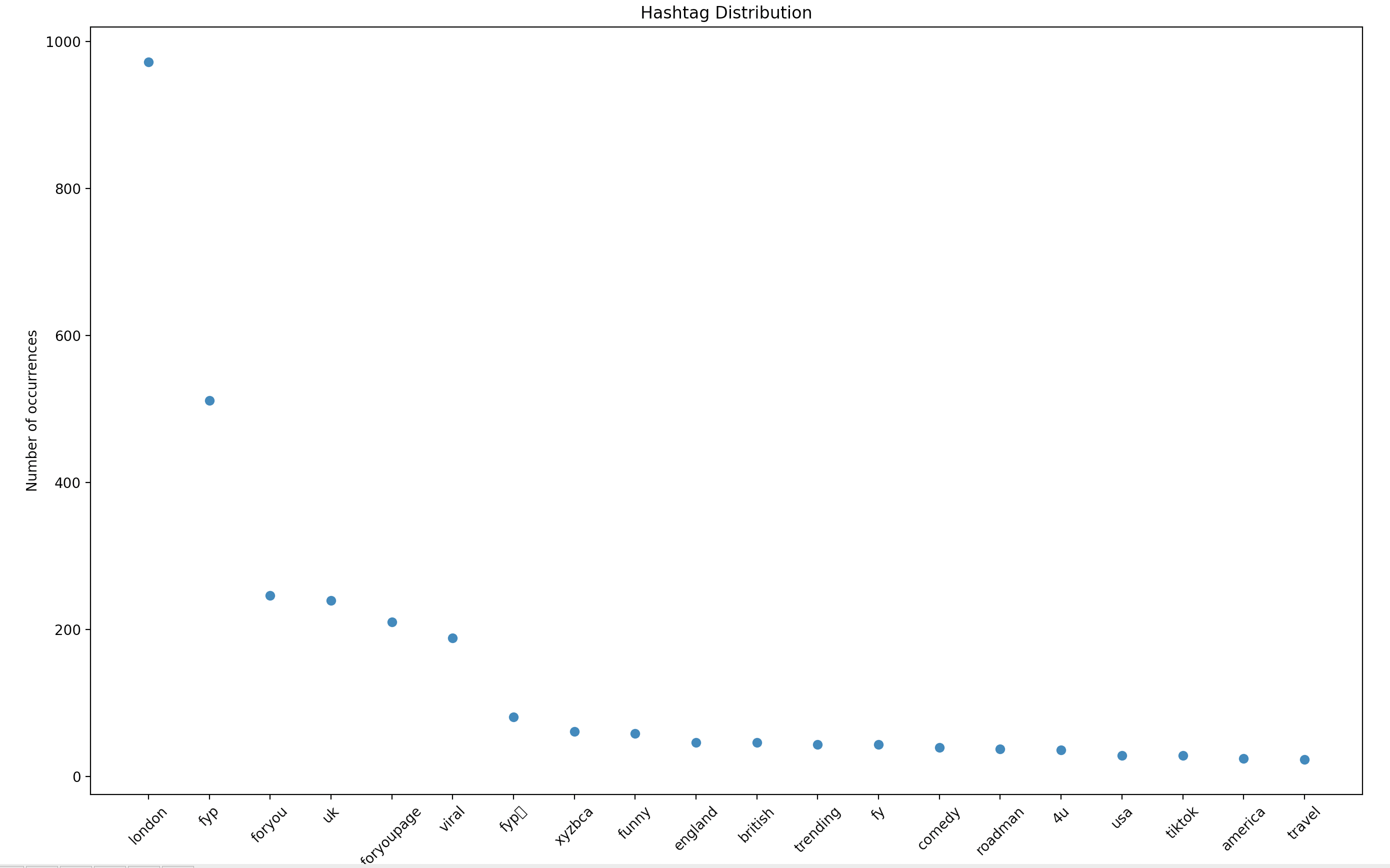
Clearly, the highest occurrence will be of the
#londonhashtag, as all posts in the filedata/london/posts/data.jsoncontain the hashtag#london. -
The results can be displayed in tabular form by executing the following command:
python3 hashtag_frequencies.py -d ../data/london/posts/data.json 20which will produce a terminal output similar to the following:
Rank     Hashtag         Occurrences     Frequency (Occurrences/Total-Posts(total_posts))
0        london          962             1.0
1        fyp             493             0.5124740124740125
2        uk              238             0.24740124740124741
3        foryou          223             0.23180873180873182
4        foryoupage      186             0.19334719334719336
5        viral           177             0.183991683991684
6        fypシ            85              0.08835758835758836
7        funny           55              0.057172557172557176
8        xyzbca          52              0.05405405405405406
9        england         45              0.04677754677754678
10       british         44              0.04573804573804574
11       trending        39              0.04054054054054054
12       fy              33              0.034303534303534305
13       comedy          32              0.033264033264033266
14       roadman         28              0.029106029106029108
15       4u              27              0.028066528066528068
16       usa             26              0.02702702702702703
17       tiktok          26              0.02702702702702703
18       travel          21              0.02182952182952183
19       america         20              0.02079002079002079
The
Frequencycolumn shows the ratio of the occurrence to the total number of downloaded posts.